

Is rinsing out your yogurt pot pointless?

You have dutifully cleaned, dried, and separated your household plastics. When you do your weekly shop, you take your plastic bags and chuck them into the supermarket’s soft plastics recycling bin. You have done your bit.
But where do your used plastics go? Despite your best efforts, your household recycling may end up in an illegal dump on the other side of the world.
The UK exports 9.25 million tonnes of plastic waste every year, making it the sixth largest exporter in the world. Instead of processing our plastic at home, waste traders pack it into shipping containers and send it to developing countries to tackle.
In the first half of 2025, the UK’s exports to developing countries rose by a staggering 84% in comparison to 2024. Malaysia and Indonesia bore the brunt of this increase in exports. The UK went from exporting 18,872 tonnes of plastic waste to Malaysia in 2024, to 28,667 tonnes in 2025. For Indonesia, British plastic grew 46 times greater in this same period.
These are not statistics that the British government is proud to admit, and it has been the work of the United Nations, non-profit organisations, and academic researchers to expose these figures. What is worse is that these figures are likely an underestimate, as a significant portion of British plastic waste travels to the Netherlands, and other European countries, before being shipped to Asian countries.
Why does the UK export its plastic waste? To maximise private companies’ profits, and to maintain the impression that we are moving towards net-zero.
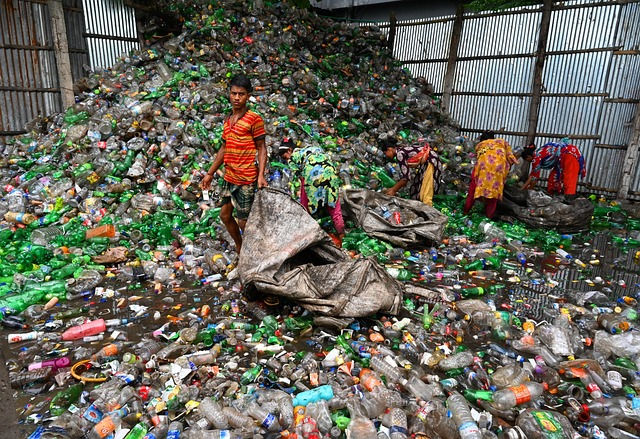
The UK and the rest of the top 10 exporters of plastic waste are responsible for 71% of all plastic waste exports worldwide, but we pass on the responsibility - and the blame - of processing our plastic waste to countries that have far less economic and infrastructural capacity to do so.
It is not the case that the UK cannot process our own plastic waste, rather we refuse to invest in building our own recycling capacity. It is easier and cheaper to send it to countries where weaker laws and enforcement enable private waste traders to avoid environmental controls and responsibilities. Campaigners have described this as ‘unethical and irresponsible waste imperialism’.
It is not enough for British consumers to follow recycling best practices. The UK government needs to step up and take responsibility for our own plastic waste on British soil. As long as plastic exports continue, the UK government is choosing private profit at the expense of developing nations’ economies, environments, and health.
Read more about how our plastic waste has polluted Indonesian communities in Part Two of this series: 'How the UK poisons Southeast Asia with plastic'
+++++++++++++++++
For more information contact: info@scarabtrust.org.uk
Images:
Garbage, Plastic cups, Recycling image - Image by EKM-Mittelsachsen from Pixabay (ST ref: 1333)
Landfill, Waste disposal, Garbage - Image by Mumtahina Rahman from Pixabay (ST ref: 1334)


Comments