

The Global Plastics Treaty - progress without consensus
- Jess Preston
- Jul 18
- 3 min read

Every 60 seconds the world produces staggering amounts of plastic. It is expected that we will produce a total of 766 million tonnes of plastic per year by 2040, equivalent to 75 trillion plastic bottles. Despite decades of recycling campaigns, the problem is only getting worse.
A new report from the Environmental Investigation Agency (EIA), Bending the Curve, argues that we cannot recycle our way out of the plastic crisis and that it is imperative we reduce plastic production at the source. Under current trends, global plastic production is expected to reach 766 million tonnes per year by 2040, while plastic waste is projected to climb to 621 million tonnes per year. This indicates that 10 million tonnes of plastic will be mismanaged, ending up in rivers, oceans, landscapes, and communities across the globe.
Subscribe to our fortnightly newsletter
Get our top stories straight to your inbox every two weeks and stay informed about plastic pollution!
For decades, recycling has been promoted as the solution. However, the report outlines that recycling cannot keep up with the pace at which plastic is entering the system, as the production of virgin plastic continues to grow at a faster rate than recycling. Plastics currently generate around 2.4 billion tonnes (Gt) of CO2 equivalent emissions (CO2e) every year, rising to 3.9 billion tonnes by 2050. Five countries account for over 70% of global primary plastic production: China, India, Russia, Saudi Arabia, and USA, with China alone contributing 36% of global production.

The report uses modelling to explore what may happen if countries agreed to place limits on plastic production as part of the proposed Global Plastics Treaty. Rather than banning all plastic, the scenarios focus on gradually reducing the production and consumption of the most common plastic polymers while encouraging greater reuse and recycling.
The EIA also highlights an often-overlooked consequence of plastic production: climate change. Manufacturing plastics relies heavily on fossil fuels, making the industry a significant source of greenhouse gas emissions. Without intervention, plastics alone could generate more than 51 billion tonnes of greenhouse gas emissions between 2025 and 2040, consuming around 39% of the remaining global carbon budget needed to keep warming below 1.5°C.

Perhaps the report’s most important conclusion is that meaningful change doesn’t necessarily require every country to agree immediately. Instead, the modelling demonstrates that a ‘coalition of the willing’, particularly when joined by major producers such as China, could significantly reduce global plastic pollution while encouraging international participation.
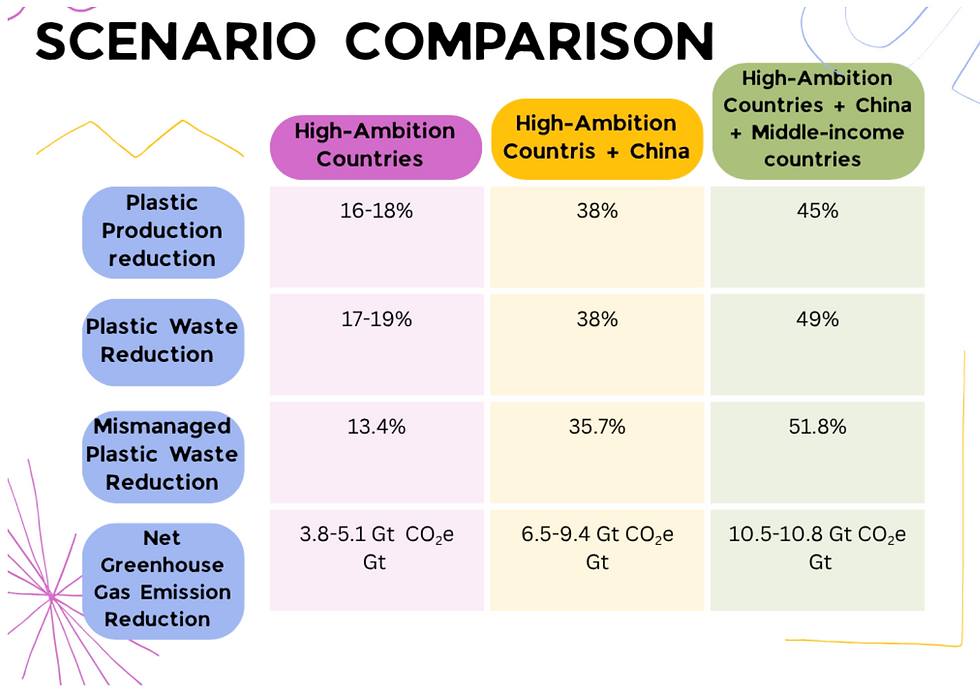
A coalition of high-ambition countries acting alone could reduce global plastic production by 16-18 % below business as usual levels by 2040. When China joins this, reductions increase to 38%. Rather than waiting for universal consensus, the Global Plastics Treaty could establish a strong baseline while allowing ambitious countries to move ahead first.
Ultimately, Bending the Curve challenges the idea that recycling alone can solve the plastic crisis. Recycling, better waste collection, and improved product design all remain essential, but they address the symptoms rather than the cause. To truly bend the curve of plastic production, we must ‘turn off the tap’ rather than clean up the flood.
+++++++++++++++++
For more information contact: info@scarabtrust.org.uk
Images:
TurnOffThePlasticTap - Image by Von Wong (ST ref: 1310)
oil refinery - WiX Media: oil-refinery
missing politicians - Image from Magnific (ST ref: 1365)
Infographic - author


Comments