

The Recycling Industry's Dirty Secret

The petrochemical industry has long championed chemical recycling as the solution to the global plastics crisis. The pitch is straightforward: instead of sending plastic waste to landfill or incineration, break it down chemically back into raw materials and start again. Clean, circular, elegant.
The reality is considerably messier.
Chemical recycling works primarily through a process called pyrolysis. Plastic waste is heated in the absence of oxygen to produce an oil that can, in theory, be turned back into new plastic. In practice, the process has fundamental limitations that its proponents rarely discuss openly. A 2024 report by Zero Waste Europe contacted two independent chemical engineering experts, both of whom categorised pyrolysis as only a form of "partial recycling" that would require enormous investment to reach commercial viability. The report also noted that insiders acknowledge the technology will not be commercially viable for another fifty years.
The contamination problem is central to this. A 2025 report by the Center for Climate Integrity found that the industry's own consultants have acknowledged pyrolysis is energy-intensive and generates substantial greenhouse gas emissions. Meanwhile, a ProPublica investigation found that from 100 pounds of plastic waste, the pyrolysis process is expected to yield only 15 to 20 pounds of reusable plastic, given losses at every stage of the process.
Shell's own trajectory says it all. After pledging to convert one million tonnes of plastic waste annually into pyrolysis oil by 2025, the company quietly abandoned that goal, calling it "unfeasible" in its 2023 sustainability report, citing lack of feedstock, slow technology development, and regulatory uncertainty.
Chemical recycling is not a solution. It is, at best, a partial measure. At worst, it is a decades-long distraction from the structural changes the plastics industry has resisted for years.
In the next piece in this series, we look at where Britain's plastic waste actually goes, and why the answer should alarm us all.
+++++++++++++++++
For more information contact: info@scarabtrust.org.uk
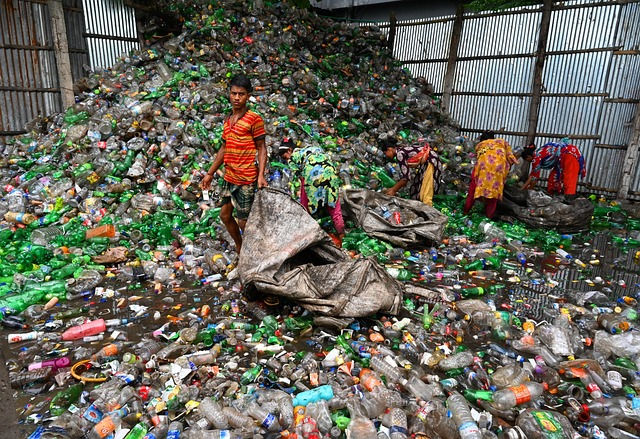
Image: global warming pollution - Image by Chris LeBoutillier from Pixabay (ST ref: 1368)


Comments